RE 10: DLL Injector
We’ve patched memory from the outside and written assembly from the inside, this time we combine both. An injector gets your DLL into the target, and the DLL installs a hook that intercepts takeDamage before it even runs. A DLL is basically the same as an .exe, its some code we can run, you can compile your c code directly into a DLL!
Memory jogs to remember what & and * mean:
`&` = address -> &dress (pronounced AND dress, get it? remember &=AND=ADDRESS!)

`*` = star -> points to a star in the sky = you have to look up where it points to = dereference = follow the pointer to find what's there!
This one kicks it up a notch with what we will be creating and learning, if you can make it through this you can tackle anything!
For this process we will be using the 9_game_trainer_game.exe we created in the last lesson, you should download the repo from github as the code has become larger and more complex, and a screenshots no longer totally suffice.
We will be creating 3 items to do DLL injection: A) A DLL injector - “10_game_dll_injector.c” B) A testing DLL to see if our injector worked - “10_game_initial_dll_injected_tester.c” C) Our complete DLL which hooks the takeDamage function - “10_game_dll_injected_extended.c”
So lets start!
A) Lets create our DLL injector:
The purpose of this process is to
- Find the process and grab its PID, just as we did in the trainer
- Open the process using the PID to get a handle
- Allocate memory inside the target process large enough to hold the DLL path string, then write the path string into that allocated memory
- Get the address of
LoadLibraryAfromkernel32.dll, then create a remote thread inside the target process pointing atLoadLibraryAwith the DLL path as its argument, this forces the target process to load our DLL - Wait until the thread finishes loading the DLL
- Clean up, free the allocated memory and close the handles. The injected DLL remains running inside the target process.
B) Now we’ve completed out DLL injector, lets create a simple testing DLL to see if it worked
Lets add DLL boilerplate, all DLLs will follow this format:
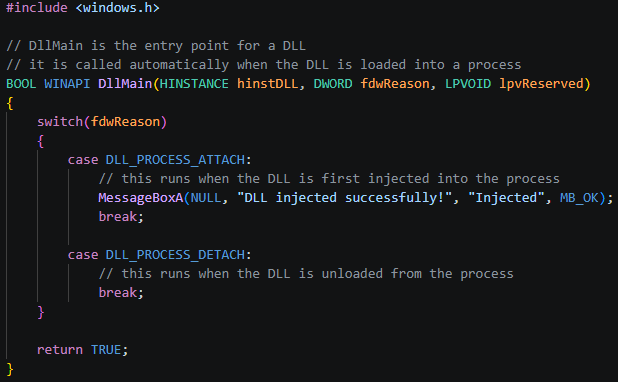 (Compile with: gcc dll.c -o dll.dll -shared -luser32)
To summarise once the DLL is loaded automatically runs DLLMain, and our switch case of DLL_PROCESS_ATTACH is run, our actual payload in this DLL is the MessageBoxA, which pops up a mesagebox.
Now to test this:
- compile the dll to be injected -10_game_dll_injected_tester.dll
- RUN the “game” exe - 9_game_trainer_trainer.exe
- update the injector to use our newly compiled tester DLL
- RUN the “injector” exe - 10_game_dll_injector.exe
Once we get that message box popup we know the injector worked!
C) Now we know our testing DLL works, lets build our actual DLL which will hook our takeDamage function and alter it as we please! This is the meaty part.
HookedTakeDamage
 explanation: why we restore original takeDamage
An analogy: Your friend wants to call the pizza shop (takeDamage) but you’ve secretly redirected their call to you (hookedTakeDamage) first.
When the call comes to you:
- You turn off the redirect, otherwise when you try to call the pizza shop yourself, it would redirect back to you again, you’d call yourself, redirect again… infinite loop
- You call the real pizza shop, order goes through normally, pizza gets made (damage gets applied)
- You do your extra thing , check if health is low, restore it
- You turn the redirect back on, ready for the next time your friend calls

Left side: what we’re creating:
void (*originalTakeDamage)(struct Character*, int)
void- the function returns nothing(*originalTakeDamage)- we’re creating a variable calledoriginalTakeDamagethat is a pointer to a function. The*inside the brackets means it’s a pointer, not a regular variable(struct Character*, int)- the function it points to takes these two arguments
So the left side just creates a variable that can hold the address of a function with that specific signature.
Right side: what we’re setting it to:
(void (*)(struct Character*, int))takeDamageAddr
takeDamageAddr- this is our raw address, avoid*with no type information(void (*)(struct Character*, int))- this is a cast, telling the compiler “treat this raw address as a pointer to a function that returns void and takes astruct Character*and anint”
Extra noob friendly explanation:
void (*originalTakeDamage)(struct Character*, int) = (void (*)(struct Character*, int)) takeDamageAddr;
// [return type] ([*name])  [argument types]       =  [cast to matching function ptr type] [the address]
Putting it together:
void (*originalTakeDamage)(...) = (void (*)(...))takeDamageAddr;
Is essentially saying:
“Create a function pointer called originalTakeDamage and point it at the address stored in takeDamageAddr, treating whatever is at that address as a callable function with this signature.”
Then originalTakeDamage(p, dmg) just calls that address like a normal function.
Next: BULD ABSOLUITE JUMP (because relative jump didnt work, my dll was being loaded >2gb away from the .exe)
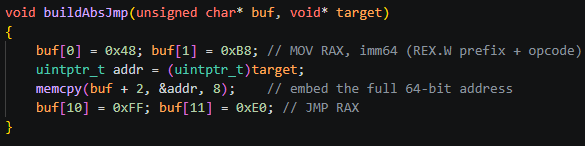
Function signature:
void buildAbsJmp(unsigned char* buf, void* target)
Takes two arguments, buf is a pointer to a 12 byte array we’ll write the instruction bytes into, and target is the address we want to jump to (in our case hookedTakeDamage).
buf[0] = 0x48; buf[1] = 0xB8;
These two bytes are the start of a MOV RAX, imm64 instruction:
0x48- the REX.W prefix, tells the CPU this is a 64 bit operation0xB8- the opcode forMOV RAX
Together they tell the CPU “move the next 8 bytes into RAX”.
uintptr_t addr = (uintptr_t)target;
Casts target (a void*) to an unsigned integer so we can copy its raw bytes. Same pattern as before - cast to uintptr_t to do arithmetic or byte manipulation on an address.
memcpy(buf + 2, &addr, 8);
Copies the full 64 bit address into the buffer starting at position 2 (after our two opcode bytes). &addr gives us the address of the integer, and we copy 8 bytes because a 64 bit address is 8 bytes. So bytes 2-9 of the buffer now contain the raw address of hookedTakeDamage.
buf[10] = 0xFF; buf[11] = 0xE0;
These two bytes are the JMP RAX instruction:
0xFF- opcode for an indirect jump0xE0- modifier specifying RAX as the register to jump to
So the CPU loads our target address into RAX with MOV RAX, then JMP RAX jumps to whatever address is in RAX.
The full 12 bytes assembled:
48 B8 [8 bytes of address] FF E0
MOV RAX, <hookedTakeDamage address>
JMP RAX
&&&
how does the hookedTakeDamage address get generated to use in this function?
When you compile the DLL, hookedTakeDamage is a function defined in your code. The compiler assigns it a memory address in the DLL’s code section. When you write:
buildAbsJmp(jmpBytes, hookedTakeDamage);
hookedTakeDamage without parentheses is not a function call, it’s the address of the function. In C, a function name without () decays to a pointer to that function, giving you its address.
So the compiler essentially substitutes hookedTakeDamage with whatever address it assigned to that function when it compiled the DLL. At runtime when the DLL is loaded into memory, that address is resolved to wherever the DLL was loaded.
TO RUN THE PROCESS
- compile the dll to be injected 10_game_dll_injected_extended.dll
- update the 10_game_dll_injector.exe with the dll we intend to use (10_game_dll_injected_extended.dll)
- RUN the “game” exe - 9_game_trainer_trainer.exe
- RUN the “injector” exe - 10_game_dll_injector.exe
Next lesson: DLL Injection and Function Hooking
We’ll write two programs — a DLL injector and a DLL. The injector forces our target process to load our DLL using Windows API calls you already know from the trainer, plus two new ones: VirtualAllocEx and CreateRemoteThread. Once injected, the DLL installs a trampoline hook on takeDamage — overwriting its first 5 bytes with a jmp to our own function, which restores health if it drops below 50, then calls the original function and reinstalls the hook.
The plan is:
- Write the injector — a standalone exe that finds
8_code_cave.exe, allocates memory inside it, writes your DLL path there, then forces it to load your DLL viaCreateRemoteThreadandLoadLibraryA - Write the DLL — starts with a simple message box to prove injection works, then extended to hook
takeDamageby overwriting its first 5 bytes with ajmpto your hook function - The hook — your hook function runs instead of
takeDamage, calls the realtakeDamagevia the trampoline, checks if health dropped below 50, restores it to 100 if so, then reinstalls the hook
So at the end you have three programs running together:
8_code_cave.exe— the targetinjector.exe— gets your DLL into the targetdll.dll— does the actual work once inside